When We’re Disconnected, Discernment Fades
When We’re Disconnected, Discernment Fades
I shared on the podcast at the end of last year that “my thorn of 2025” was my Grandma’s decline. As the words left my mouth, I remember feeling a sense of finality, a deep inner knowing. Sadly, just a few weeks later, we shared our last moments together on January 9, 2026 in Vancouver, Canada. I was beyond grateful to make it in time to be by her side in her final days. She was my one and only Grandmother, and we shared a special bond.
As I flew back to LA that afternoon, headed home from holding her hand for the last time, I kept thinking about the messages “Gram” had always repeated to me.
“Call your Dad.”
“Slow down.”
“Take care of yourself and be careful.”
I often dismissed them, assuring her that I had talked to my Dad. Despite the workload and international travel, I did not need to slow down. And I was in fact taking care of myself. At times, her cautious reminders felt like proof that she didn’t quite get me. I wondered if she misunderstood my ambition or saw it as a distraction from the values she hoped our family would carry forward.
Sitting in my window seat and watching the clouds drift below, I had a realization. Her message to me was the same philosophy I’ve come to live and build by, simply spoken in her own words.
Connect.
Reflect.
Refine.
With intention.
• • •
Call Your Dad
“Have you talked to your Dad? You should call your Dad.”
Gram wanted me to stay connected to family, always. Our family has known seasons of deep joy and deep pain, but she never wavered in showing us what it meant to stay connected and to love.
At nineteen, Gram moved alone from Vancouver to Los Angeles to be near a friend from school and the beach. She loved the Santa Monica sunshine and the ocean breeze. Her parents soon followed, and she spent her life joking that she couldn’t shake them, when in truth connection and family were embedded in the very clay that shaped us.
She had my Dad and my Uncle in her twenties and soon found herself a single mom, raising two young boys on a grocery store salary. My Papa struggled with alcoholism and couldn’t show up as the father our family needed. He left, they separated, and life went on. Years passed. The boys grew up. My Gram remarried. My Papa got sober. My Dad eventually brought him into our home to give him a chance at a new chapter.
By the early 90s, Gram had tragically lost her second husband to an unexpected brain aneurysm. She moved back to Vancouver to be closer to her aunts, uncles, and cousins. She would still come to stay with us in LA for long stretches, spending mornings over coffee and a cigarette with my Papa or taking long walks by the beach together. Yes—my Papa. Her ex-husband. The man who had once left her to raise two boys alone.
That impact of that reconciliation never made sense to me until much later. The grace, forgiveness, and quiet love she extended to him remain extraordinary to me. Years later, as my Papa’s health declined due to early dementia, he was moved back to Vancouver for care. Gram was there every day, visiting him until his final moments.
There are countless examples of her devotion to connection. She stayed close to my mom, her son's ex-wife, even after my parents split when I was just two. She remained connected to my mom’s brothers as well. Late in 2024, she called me specifically to ask me that I reconcile with my mom's youngest brother when she learned he was ill. “Life is too short, Ali,” she said. My Uncle passed within six months. I’m grateful I listened.
Connection to Gram was never about obligation. It wasn’t just blood. It wasn’t something we did. It was who we were.
And still, connecting with her was not always easy. It was complex.
• • •
Slow Down
Gram was unimaginably strong-willed. In her later years, we spent many afternoons sitting in her living room, cups of coffee within reach, the news on in the background on low, time stretching in a way it rarely does anymore. We weren’t rushing anywhere. There was nowhere else to be. We sat, and we talked, and often we disagreed.
I had my opinions. She had hers. And she had plenty of them.
“Women shouldn’t wear their hair long after thirty.”
“Our hair looks better blonde.” (yes, I should mention we are brunettes with olive skin and Greek by background...go figure)
“Smoking shouldn’t be banned in entire neighborhoods and definitely not in hotels.”
“Parents let their kids talk back too much these days. They're cheeky.”
Her opinions were known to drive some family members crazy. But over time, they stopped bothering me as much. Sitting with her taught me something quieter and more valuable. Slowing down made room for disagreement without escalation. We didn’t shout. We didn’t rush to win. We stayed seated. We listened. We let the conversation breathe.
Those hours gave me the chance to practice gentle disagreement. To hold my own perspective without needing to overpower hers. And after many of these conversations, there was always a moment of stillness. A pause. She would shrug her shoulders, look away for a beat, and say, “Hm.”
That was the gold.
Those moments taught me that reflection doesn’t always look like agreement. Sometimes it looks like restraint. Sometimes it looks like silence. She may not have changed her mind, but she had heard me. And in being heard, something shifted. A new perspective entered the room, or at least something worth sitting with a little longer.
“Slow down” was her way of teaching me how to make space. Space for another person. Space for a point of view that wasn’t my own. Space for reflection. Space to notice how I was moving through the world. Slowing down gave us room to stay connected, even in disagreement, and to return, again and again, to what actually mattered.
• • •
Take Care of Yourself and Be Careful
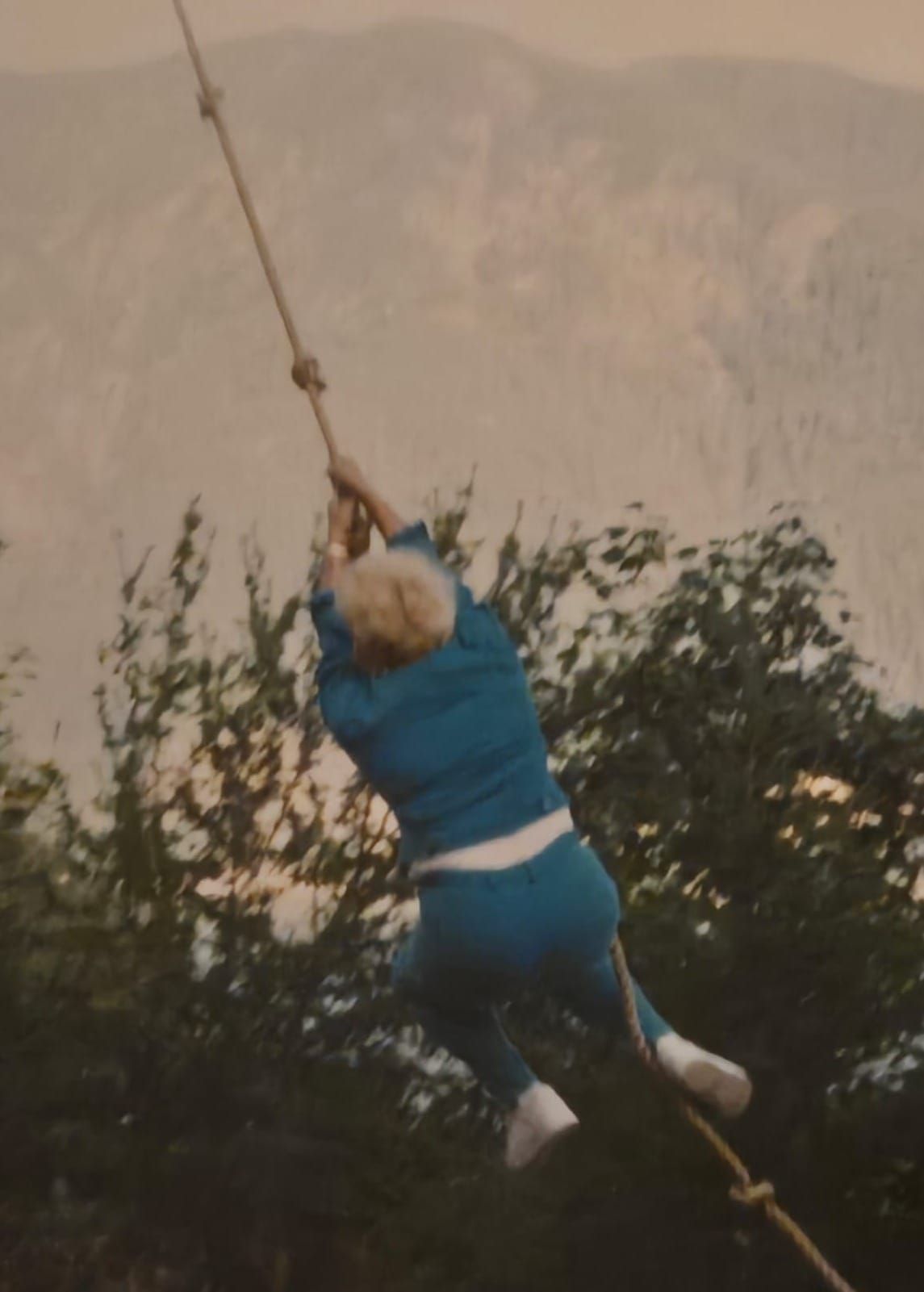
For a woman born in 1941, Gram was courageous, open-minded, and progressive. She ran to Los Angeles as a teenager. She raised boys who challenged her daily. She embraced people of all races, religions, and sexual orientations. In later years, taught me how to ride the city bus and we explored the vibrant layers of her city by foot. Miles and miles of walking through the city of Vancouver.
Standing at 4’9”, she was rarely afraid to walk alone.
“Take care of yourself and be careful” were never warnings. They were instructions for longevity. For discernment. For staying connected to myself long enough to keep going.
Without care and awareness, ambition collapses. Without reflection, refinement isn’t possible.
Her message was never to stop. I see that now. It was to go forward with intention. To learn from mistakes without losing yourself in the process. To explore the world. To notice beautiful places and people. To choose rooms and relationships that want the best for you. Her repeated phrases weren’t instructions. They were systems of care.
Losing my Gram didn’t give me new wisdom. It clarified what had always been there.
Connection is not a soft value. It is a prerequisite for discernment. Reflection requires space. Refinement requires care.
When we stay connected to ourselves and to the people who anchor us, choosing well becomes less effortful. It becomes natural.
That was her gift. Offered with strong opinions, an unmistakable point of view, and a reminder that love doesn’t always arrive gently. And it’s the practice I carry forward every day.
Ali