Still Here
I grew up in Los Angeles knowing two things very early: that life could be complicated and that complicated was not an excuse.
· · ·
My parents were young when they had me and split before I was two. I grew up with younger sisters on both sides of my new blended family, all of us loved fiercely by parents doing the best they could with what they had. But the path was not smooth. There was hardship in both houses. Real hardship. The kind that teaches you, very young, how to read a room, how to manage other people's emotions, how to keep things together when things are coming apart.
I spent a lot of my childhood being the one who held it together. I was good at it. And somewhere along the way, being good at it became the whole story I told myself about who I was.
· · ·
The external version of that story looked impressive. Good grades, cheerleading, dance, student government, writing for the school paper, a big social life and a bigger work ethic. I was involved in everything, driven from the start, and allergic to stillness in a way I did not yet understand. I babysat, I worked odd jobs, I was always earning something. I wanted to build things. I wanted to go somewhere.
And I did.
I went on to lead global events for a major real estate firm, hosting high net worth clients in London, Amsterdam, Berlin, Singapore, Hong Kong, NYC and beyond. Business class seats and industry recognition and the particular, addictive satisfaction of being the person in the room who makes everything run smoothly. I was named Young Leader of the Year. I sat on boards. I married my best friend, a boy I had met in 9th grade, someone whose family felt like an extension of my own. We bought a house. We had two daughters. We bought another house. We kept climbing. I kept climbing. I was, by most measures, succeeding at everything.
And then I sat across from my therapist and she asked me a question I was not prepared for.
What do you do for yourself?
I thought about it. I actually thought about it...
Manicures. I get manicures.
· · ·
I want to sit with that for a second, not for some dramatic effect but because it is common. I think there is a version of that answer living quietly inside a lot of women reading this right now. Maybe yours is not manicures. Maybe it is Target runs or the gym, which sounds like self-investment but is really just another performance metric you are grading yourself on. Maybe it is nothing at all, and the silence after the question is the part that keeps you up.
The point is not the answer. The point is that the question existed and I didn't know how to answer.
Because the truth is I used to be a different woman. I used to take ballet classes and sew at the local fabric store workshops. I used to make art, travel for the love of it, stay out late dancing and laughing with friends until two in the morning. I used to have a life that was mine, not just managed well, but actually, joyfully, specifically mine.
Somewhere between the mortgage and the meetings and the school pickups and the performance reviews and the volunteer roles and the family traditions, I had made a trade I never consciously agreed to. I had not added responsibility to a full life. I had let it replace one.
I did not recognize the woman in the room that day. I didn't even get manicures often...
· · ·
Here is what I have come to understand about that moment and the years that led to it: I had spent most of my life chasing a gold star. Not because I was greedy or vain but because I had grown up in complicated circumstances and I had decided, somewhere deep and unspoken, that if I did everything right, if I was the good daughter, the good student, the good employee, the good wife, the good mother, I would be safe. I would be different. I would have built something that could not fall apart.
The gold star was my armor. And I had been wearing it so long I had forgotten what it felt like to take it off.
The messy circumstances of my upbringing were never a crutch. I knew that. I had always known that. What I did not see until much later was that they had quietly shaped every decision I made for decades, including the decision to give everything to everyone else and keep almost nothing for myself. I had confused self-erasure with strength. I had mistaken the performance of having it together for actually being okay.
· · ·
That therapist's question cracked something open. I started asking different ones.
What had I actually wanted? What had I traded away without realizing it? What was still in there, under all the delivery and the achievement and the armor? Who am I?
I did not have the answer yet. Then the pandemic arrived and did something I had not been able to do for myself: it made everything stop.
At first the stillness felt like relief. My anxiety eased up for the first time in years. Then the clarity started to feel like an invitation. I started cooking slow meals and making art and getting my hands into the garden. I launched a residential interior design side business and discovered that people wanted what I had been doing quietly for years. The phone kept ringing. Something was waking back up.
The answer, it turned out, was quite a lot.
· · ·
I rebuilt things slowly and then all at once. I left my corporate role. I continues to design and I simultaneously built Strick Studios, an experiential marketing agency that now operates across coast to coast. In building these companies I remembered what it felt like to create something from a genuine point of view rather than a job description. I started designing events and spaces from my own vision, not a client brief.
My marriage ended, not with bitterness, not with a villain, but with the particular quiet grief of two good people who had grown into different versions of themselves. We chose something harder and more honest than staying. We chose to rebuild, as a family, differently configured, with the same love underneath it. We celebrate holidays together. We talk most days. The relationship did not end. It just changed shape into something that fits us both better and serves our girls more honestly than anything we could have forced.
Last weekend at my oldest daughter's soccer game, her dad was on the field coaching while our six-year-old sat sideline holding hands between me and his girlfriend while we caught up. My boyfriend was chatting with the girl's grandparents a few chairs over. All of their people, in one place, without a seam showing. The pride I have in what we have built around those girls is endless.
I am in a partnership now that fits the woman I have become, not the one I was performing. That matters more than I know how to say without making it sound like a caption.
· · ·
I want to be careful here, because this is the part where most stories like this become tidy. She lost herself, she found herself, she built the thing, she is healed. Applause.
That is not what happened. What happened is slower and less photogenic than that. I am still finding myself. Still. I am still, on certain Tuesdays, reaching for the gold star instead of the thing I actually want. I still have weeks where my calendar looks like a hostage negotiation and my own name is not on it. The difference is that I notice now. I call it out. And I have built a life where noticing leads somewhere different. I get ahead of it.
· · ·
I launched Refine Social Club because the room I needed in 2019 did not exist.
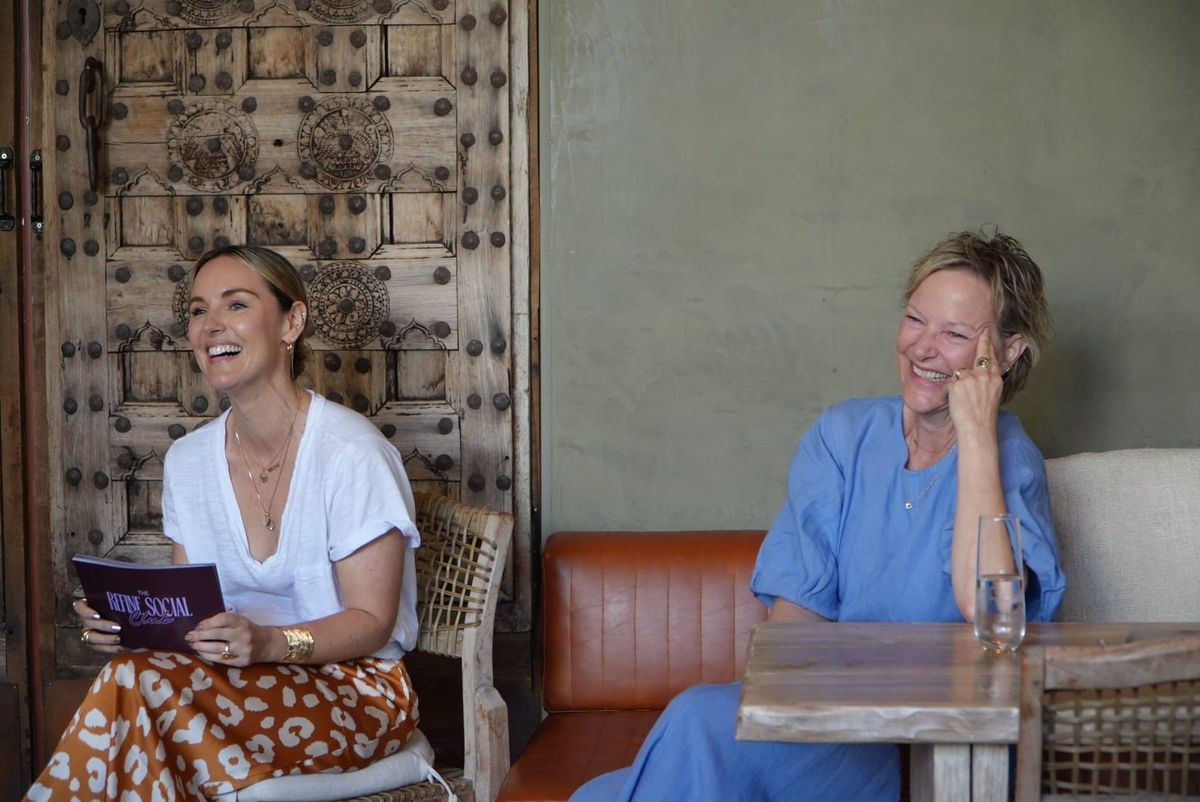
In May 2025 we hosted our very first event, a Mother's Day weekend salon that set the tone for everything that would follow. I sat on a stage with my therapist and talked about the complex arc of mother and daughter relationships, from birth through death, through every season in between. Then I brought my mom up and interviewed her about raising three daughters without ever having been mothered herself. Her mother died by suicide when she was seven years old.
The room was quiet in the way rooms go quiet when something true is being said in public for the first time.
We ended the morning with coffee and champagne and reflection cards and a bloom bar, women making bouquets for themselves or for a mother in their life. The conversations that followed covered menopause and puberty arriving in the same household at the same time, a baby brought home through surrogacy, the grief of complicated mothers and the complicated grief of losing them.
Women told me afterward: we need this. We have been waiting for this.
I know they mean it because I was one of them not very long ago, sitting in a therapist's office with nothing to say for myself except manicures, quietly unraveling in a life that looked perfect from the outside.
· · ·
The work of Refine, the events, the editorial, the podcast, my speaking, all of it, is built on a single belief I came to the hard way: that when women stay connected to themselves, to each other, and to what actually matters, they do not just feel better. They become more of who they already were. They show up better for their partners, their children, their teams, and the world. They stop performing a life and start living one.
I know this because I lived the alternative. I know what it costs and what it takes to come back from it.
I also know, and this is the part I need you to hear, that you are not as far gone as you think. The woman you used to be, the one who danced and made things and had a point of view and took up space without apology, is not gone.
· · ·
She is still here.
She is just waiting for the right room.
Ali